

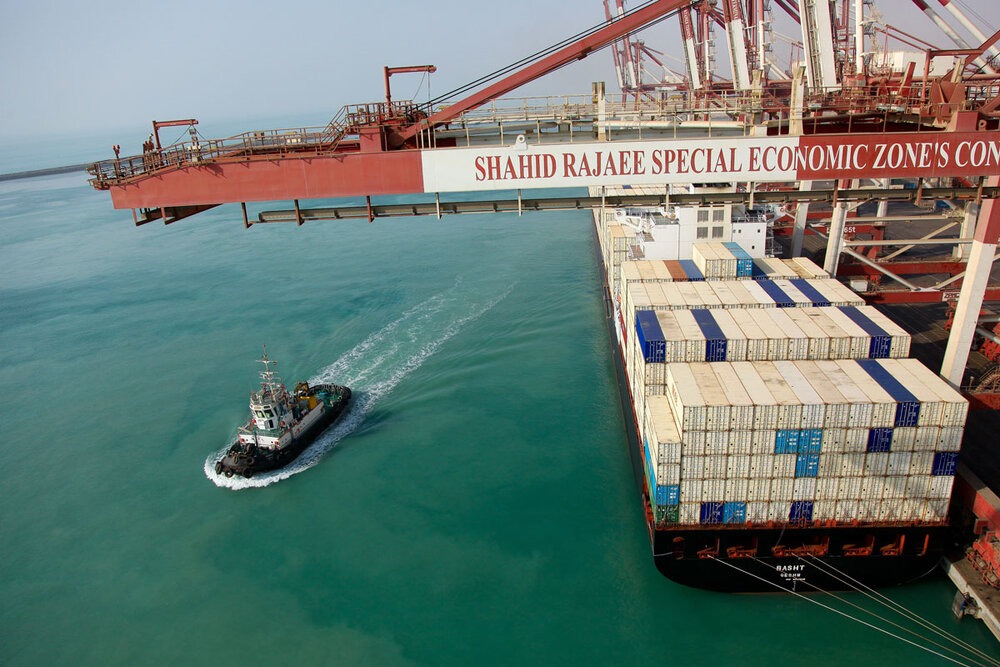
Kazakhstan has formally reaffirmed its critical step in its transit strategy spanning Central Asia to the Middle East, keeping on the agenda its plan to establish a specialized transportation and logistics terminal at Shahid Rajaee Port, Iran's largest commercial port. During his address at the Kazakhstan–Iran Business Forum held in Astana on December 11, Kazakhstani President Kassym-Jomart Tokayev identified this terminal as one of the key projects of his nation's long-term logistics vision.
According to Tokayev, cargo volumes on the Kazakhstan–Turkmenistan–Iran railway line could double by 2030. To manage this increase sustainably, the Kazakh terminal planned at Shahid Rajaee is positioned as a foundational infrastructure element enabling rail-to-sea integration. President Tokayev emphasized that Kazakhstan sees itself as one of Eurasia's key transportation and logistics hubs.
Role in Eurasian Transit and the Iranian Dimension
In his remarks, Tokayev recalled that approximately 85% of cargo shipments between China and Europe transit through Kazakhstan's territory. In this context, Iran is viewed by Kazakhstan not merely as a bilateral trade partner, but also as a strategic gateway providing access to open seas. Access via Iran to the Persian Gulf and broader global markets aligns with Kazakhstan's objectives to develop alternative transit routes bypassing Russia.
The planned terminal is expected to provide direct maritime access for Kazakhstan's exports while also supporting transit loads from other Central Asian countries. This structure will transform the Kazakhstan–Turkmenistan–Iran railway line into a multimodal (rail–sea) logistics chain.
Inter-Port Connections and Scope Expansion
Kazakhstan aims to deepen cooperation with Iran not only through Shahid Rajaee but across a broader port network. Tokayev has prioritized strengthening connections among:
Kazakhstan's Aktau and Kuryk ports,
Iran's Amirabad and Anzali ports,
as well as Bandar Abbas and Chabahar
This approach aims to create alternative and flexible logistics routes along the Caspian Sea – Iran – Persian Gulf corridor.
Institutional Foundation: 2025 Agreement
The Shahid Rajaee terminal plan is built on an investment memorandum of understanding (MoU) signed in April 2025 between Iran's Ports and Maritime Organization (PMO) and Kazakhstan's public institutions. Under this MoU:
Land allocation in the port's backshore area to the Kazakh side is envisaged,
Kazakh institutions are required to submit commercial and investment proposals within 30 days,
An investment agreement is planned to be signed following PMO board approval.
PMO interim chairman Saeed Rasouli describes Iran as "a gateway to open seas" for Kazakhstan and emphasizes that the country's 1,800 km coastline offers strategic advantages for Central Asia.
Shahid Rajaee Port: Capacity and Signal of Confidence
Shahid Rajaee Port, located near Bandar Abbas and adjacent to the Strait of Hormuz, stands out as Iran's most critical commercial port. The port handles 75–83 million tons of cargo annually, accounting for 85–90% of Iran's total container volume and more than half of the country's total trade volume.
The port experienced a major explosion and fire on April 26, 2025, in which at least 57 people lost their lives and more than 1,000 people were injured. However, Iranian authorities reported that days after the incident, cargo operations resumed gradually, with customs and railway volumes reaching or exceeding pre-incident levels by late April. Kazakhstan's decision to proceed with the terminal plan is seen as a clear signal of confidence in the port's operational recovery.
Broader Strategy: Non-Russian Routes
Kazakhstan's Shahid Rajaee investment is part of a strategy of positioning logistics assets directly on key corridors. In June 2025, Kazakhstan opened a multimodal terminal at Poti Port in Georgia to support the Middle Corridor. Cargo transported via Poti reached approximately 4.5 million tons last year, with mid-term targets of 10 million tons.
Similarly, the Iran route creates a southbound alternative for Kazakhstan that bypasses Russia. Iran is also encouraging regional countries to invest in Shahid Rajaee and other Persian Gulf ports; Uzbekistan has already signed a separate memorandum for a logistics hub at Shahid Rajaee.
Overall Assessment
Kazakhstan's reaffirmation of its plan to establish a special terminal at Shahid Rajaee Port demonstrates Iran's increasingly strengthened role in Central Asia's struggle for maritime access. If realized, the Kazakhstan–Turkmenistan–Iran rail-to-sea chain will strengthen, making Central Asia's access to Middle Eastern and global markets more diversified and resilient.
Key Points:
Kazakhstan has reaffirmed its plan for a special logistics terminal at Shahid Rajaee Port.
The terminal aims to strengthen the Kazakhstan–Turkmenistan–Iran corridor.
Cargo volumes are expected to double by 2030.
The project is based on an April 2025 MoU.
Shahid Rajaee handles 85–90% of Iran's container traffic.
The investment aligns with a strategy to strengthen non-Russian transit routes.
Author: SedatOnat.com
We would be happy to receive your feedback.
Wishing you good reading from the start.

