

According to new research from Gartner Inc., supply chain and procurement leaders can better manage resource constraints by focusing on acute risks that threaten business survival rather than long-term challenges. These findings show that leading supply chains mobilize stakeholders by directing their attention to immediate and tangible problems. Paradoxically, this approach can be more effective than directly addressing long-term constraints.
Gartner experts explained that they have identified three main barriers preventing supply chain leaders from taking sufficient action to address resource constraints. These results were obtained from a survey conducted in January 2024 with 143 supply chain leaders and were presented this week during the Gartner Supply Chain Symposium/Xpo in Barcelona, Spain.
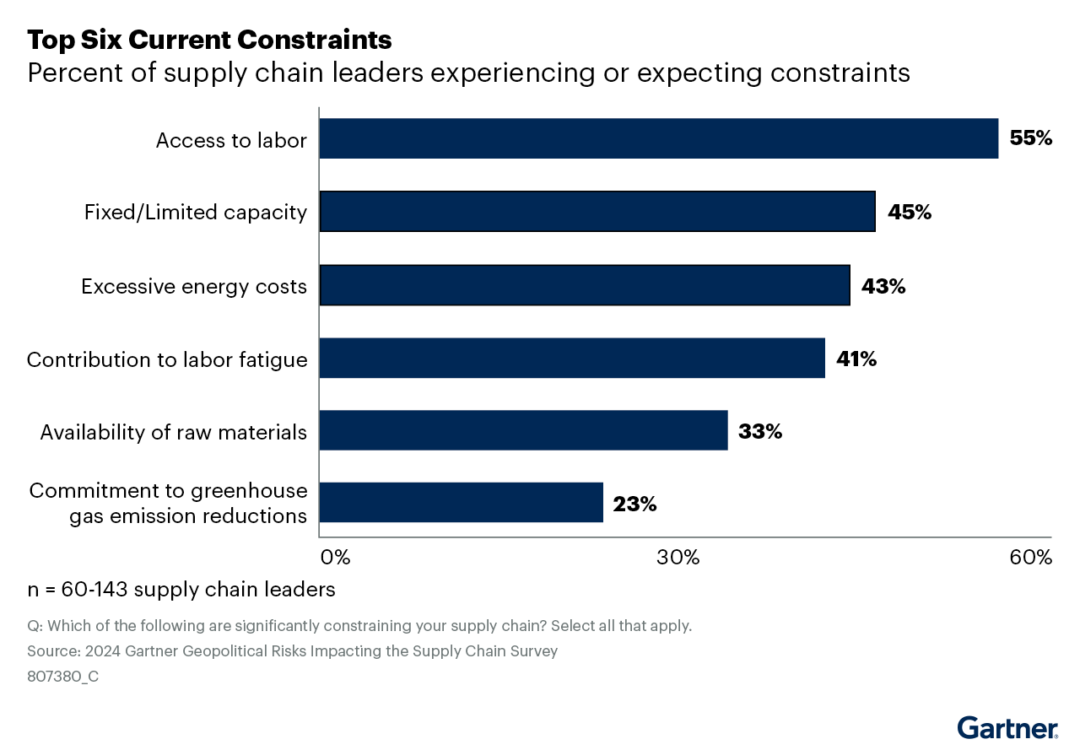
The survey revealed six major constraints faced by supply chain leaders today: access to labor (55%), fixed/limited capacity (45%), excessive energy costs (43%), contributing to labor fatigue (41%), raw material availability (33%), and commitment to reducing greenhouse gas emissions (23%).
To gain stakeholder support in addressing these issues, the most effective approach is to emphasize short-term and immediately visible impacts on business survival. This approach provides a foundation for designing solutions to address long-term resource constraints, which will be further exacerbated by the future impacts of climate change.
Laura Rainier, Senior Director Analyst at Gartner Supply Chain Practice, stated: "When leaders focus on the obvious and current dangers before them, it is difficult to take action on long-term constraints. Rather than waiting for an authority that may never come, supply chain leaders can design solutions that address both current and future constraints by working with today's short-term pressures."
The research identified three action categories where supply chain leaders need to shift their strategies:
De-prioritize Long-Term Constraints: Long-term strategies can be de-prioritized in the event of supply chain disruptions. Therefore, supply chain leaders should focus on obtaining investments and stakeholder support that will address the constraints their organizations currently face.
Re-prioritize Long-Term Constraints to Design Solutions: Supply chain leaders can have a significant impact on product design, ensuring that both current and future constraints are part of the design process. By starting with designing resource constraints out of new products, they should gradually bring more sustainable and feasible products to market.
Use the Market to Learn and Innovate: The best supply chains develop new solutions by creating learning opportunities and rely on external partners such as innovators, startups, and solution providers to overcome technical and regulatory barriers.
Key Takeaways
Gartner Inc. determined that supply chain leaders can better manage resource constraints by focusing on acute risks.
In a survey of 143 supply chain leaders conducted in January 2024, six major constraints emerged: access to labor, fixed capacity, energy costs, labor fatigue, raw material availability, and reducing greenhouse gas emissions.
The most effective way to gain stakeholder support is to emphasize short-term impacts on business survival.
Supply chain leaders should focus their strategies on three categories: de-prioritizing long-term constraints, re-prioritizing long-term constraints to design solutions, and using the market to learn and innovate.

