

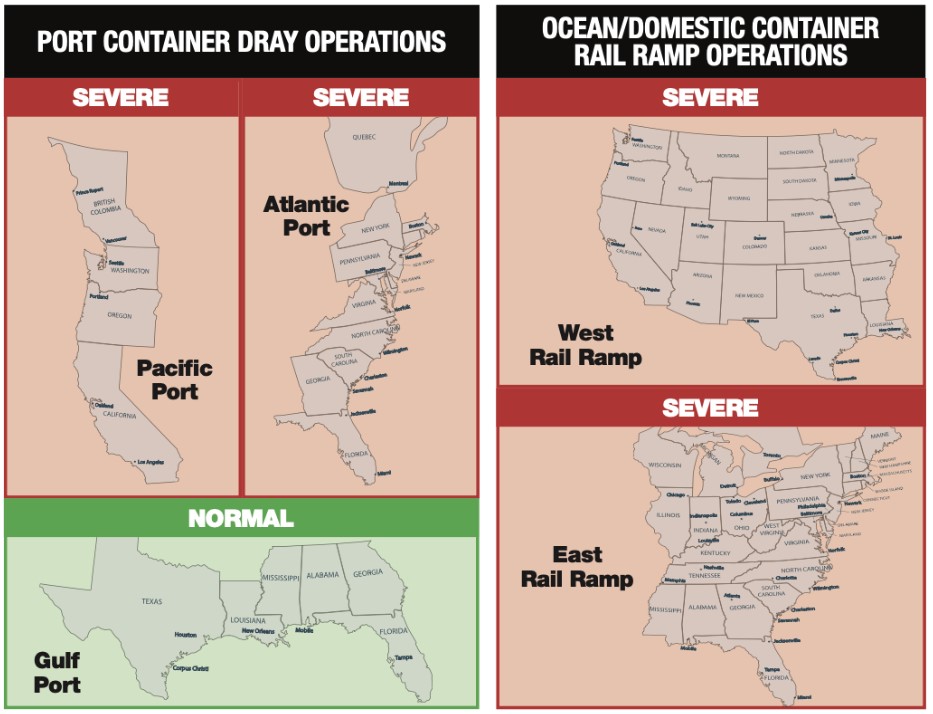
A potential strike by Canadian railway workers is creating significant strain on U.S. West Coast port facilities. According to a report prepared by ITS Logistics, shippers are rerouting containers from Canada to the U.S. to avoid potential operational disruptions. This adds further pressure on a chain of effects that began when the Francis Scott Key Bridge at Baltimore Port collapsed, leading to port closure.
In particular, Norfolk Port is experiencing significant increases in dray and container storage capacity. This increase stems from demand shifts spreading across the U.S. East Coast. Inland point intermodal (IPI) container dwell issues continue at Los Angeles and Long Beach (LA/LB) ports.
According to ITS Logistics' report, a strike at Canadian National Railway (CN) and Canadian Pacific Kansas City (CPKC) was set to begin on May 22, but was postponed this week due to a review process conducted by the Canada Industrial Relations Board (CIRB).
According to the report, strikes would particularly impact ramp operations in the U.S. Midwest and Toronto. The optimal operational plan is to terminate imports at the port of entry and use dray off, transload, and one-way truck transportation to move freight to DC networks.
ITS recommends adopting a similar strategy for exports and making reservations from the port/container yard (CY). One-way truck loading near the port or terminal, transload, and dray into the terminal will prevent delays on the railway. Industry professionals should consider transportation providers with multimodal, North America-wide networks to fulfill current demand.
Key Takeaways
A Canadian railway worker strike is causing operational challenges at U.S. West and East Coast ports.
The closure of Baltimore Port led to increases in dray and storage capacity at Norfolk and other East Coast ports.
Container dwell and flat car imbalance issues continue at LA/LB and SEATAC ports.
Due to the strike, ramp operations in the U.S. Midwest and Toronto will be negatively affected.
ITS Logistics recommends alternative strategies for export and import operations.

