

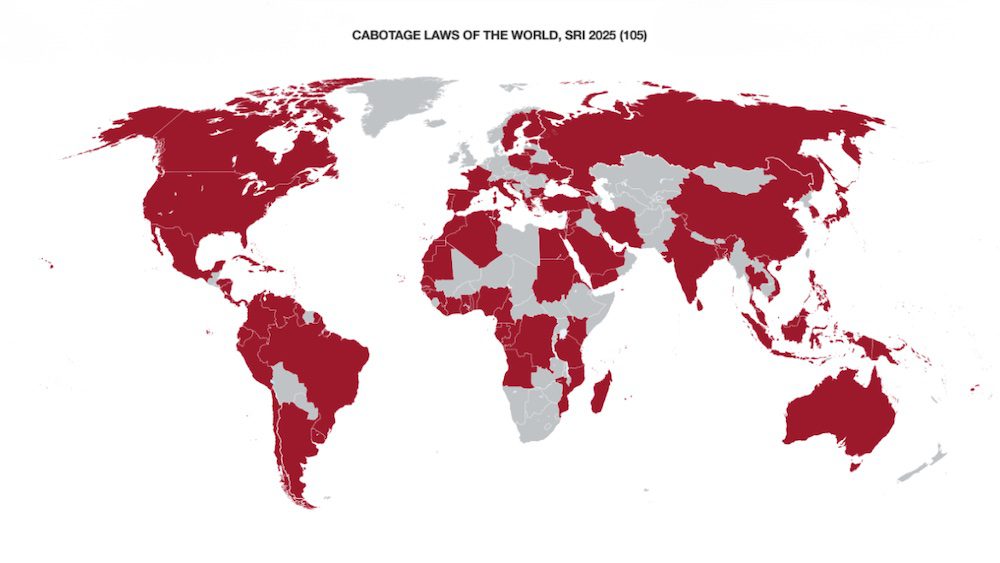
According to a new report published by Seafarers' Rights International (SRI) on behalf of the International Transport Federation (ITF), the number of countries enforcing cabotage laws has increased from 91 in 2018 to 105 in 2025.
These countries now control 85% of global coastlines — marking the fastest expansion period for cabotage rules in maritime history.
The report, titled "Cabotage Laws of the World," reveals that the findings show rising geopolitical uncertainties in the post-pandemic era are driving countries to strengthen maritime sovereignty.
Cabotage: From Economics to National Security
According to Deirdre Fitzpatrick, Executive Director of SRI and co-author of the report, cabotage is no longer viewed solely as an economic tool but rather as a cornerstone of national security strategy:
"Countries are increasingly viewing cabotage not simply as economic policy, but as an integral part of strategic autonomy and national security in an increasingly unstable geopolitical environment."
Fitzpatrick noted that these 105 countries represent a geographically diverse group, emphasizing that growing awareness is translating into concrete legal measures.
The U.S. Jones Act: A Global Reference Point
The United States stands as the strongest enforcer of cabotage laws.
In the country, maritime cabotage is governed by the Jones Act of 1920.
This law mandates that cargo transported between U.S. ports must be carried exclusively by U.S.-built, U.S.-flagged, U.S.-owned, and U.S.-crewed vessels.
David Heindel, President of the Seafarers International Union and Chair of the ITF Seafarers' Section, stated that the report validates views long championed by the maritime community:
"The Jones Act represents the model that best serves the interests of the United States, our seafarers, and our national security.
It is no surprise that countries facing today's geopolitical challenges are strengthening their own cabotage regulations."
Economic Impact: 650,000 Jobs and $150 Billion in Value
The Jones Act holds significant importance not only from a national security perspective but also economically.
U.S. cabotage fleet: Approximately 40,000 vessels
Employment impact: 650,000 people
Economic contribution: $150 billion annually
Additionally, the law supports strategic sealift capacity for the U.S. Armed Forces.
Jennifer Carpenter, President of the American Maritime Partnership, defended the law as follows:
"We do not allow foreign airlines or foreign trucking companies to transport passengers or cargo between U.S. cities, and the same principle applies to maritime commerce.
Protecting our own maritime boundaries and supply chains cannot be left to the decisions of foreign carriers."
Global Trend: National Sovereignty and Strategic Autonomy
According to the report, the expansion of cabotage laws is not limited to the United States.
Similar strong regulations are being enforced in the following countries:
South Korea
Japan
Israel
Brazil
Türkiye
China
Most of these countries aim to keep critical maritime shipping services under local control during crises, protect supply chains from dependence on foreign operators, and achieve self-sufficiency in defense logistics.
Geopolitical Context: Rising Tensions and Maritime Sovereignty
In the post-pandemic era, energy supply, supply chain security, and regional conflicts have driven countries toward a "strategic autonomy" approach in maritime shipping.
Cabotage laws protect local workforces and merchant fleets while simultaneously functioning as an economic defense mechanism against foreign influence.
According to the SRI report, this trend is accelerating among countries in Asia, the Middle East, Latin America, and Africa.
Conclusion: Maritime Sovereignty Has Become a Global Priority
As of 2025, 105 countries have placed cabotage laws at the center of their national strategies.
This figure is viewed not merely as an indicator of economic protectionism, but also of geopolitical resilience.
Cabotage is no longer merely a mechanism for regulating domestic trade; it has become a cornerstone of maritime security, strategic infrastructure, and economic independence.
Key Takeaways:
The number of countries enforcing cabotage laws increased from 91 in 2018 to 105 in 2025.
These countries control 85% of global coastlines.
SRI report: "Cabotage is no longer economic policy but a matter of national security strategy."
The U.S. Jones Act serves as the global reference model.
The Jones Act provides 650,000 jobs and $150 billion in annual economic contribution.
South Korea, Japan, Israel, Brazil, Türkiye, and China are among other countries with strong cabotage laws.
Global trend: Strengthening maritime sovereignty in response to geopolitical instability.
Experts foresee cabotage becoming as critical as strategic infrastructure security in the future.
Wishing you happy reading in advance.

