

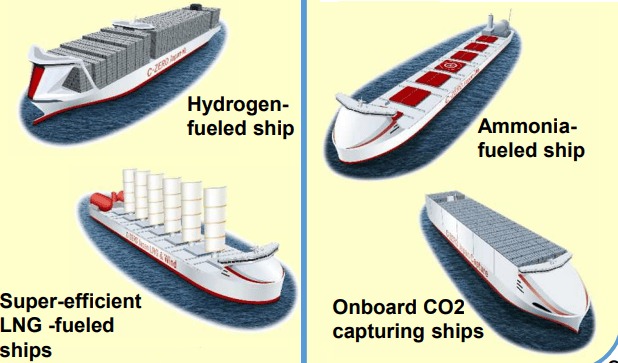
A long-anticipated structural transformation in Japan's maritime and shipbuilding sector is accelerating with a major step taken during November–December 2025. Seven major Japanese players — Mitsubishi Shipbuilding, Imabari Shipbuilding, Japan Marine United (JMU), Nihon Shipyard (NSY) and three major liner operators Kawasaki Kisen Kaisha (K Line), Mitsui O.S.K. Lines (MOL) and Nippon Yusen Kabushiki Kaisha (NYK Line) — have signed a memorandum of understanding (MoU) to develop a common standard design framework for next-generation LCO₂ carriers and alternative-fuel vessels.
\nAt the heart of the MoU lies MILES Co., Ltd., Japan's unified ship design platform. Previously focused on LNG carrier designs under the name MI LNG, the company is expanding its scope as of 2025 to concentrate on low-carbon ship types such as LCO₂ transport vessels and ammonia-fueled vessels. The platform aims to accelerate Japan's transition to a green fleet by establishing the sector's common design architecture.
\nUnder the agreement, MILES will prepare baseline design sets for LCO₂ carriers and vessels using alternative fuels. These designs can subsequently be produced concurrently by different shipyards using a multi-yard construction model. This approach will enable the same vessel type to be built in parallel at Japan's different shipyards. In turn, economies of scale will increase, delivery times will shorten, and Japan's global competitive strength will strengthen.
\nThis common design strategy represents a continuation of the LCO₂ carrier standard specifications research initiated by the same companies in August 2024. At that time, the companies both defined technical requirements for LCO₂ transport and began examining a similar standardization approach for alternative-fuel vessels. The new MoU aims to transform these efforts into concrete production projects.
\nThe research ecosystem is not limited to shipyards alone. The three major Japanese shipping companies K Line, MOL and NYK Line are investing in MILES to enhance the platform's cross-industry cooperation capabilities. Similarly, JMU and NSY are joining as partners to support widespread adoption of the announced design standards across Japan.
\nThis common design structure represents a critical move not only in terms of developing eco-friendly vessels but also in addressing the structural pressures Japan faces in global maritime competition. Facing the serial production capacity of China and South Korea, Japanese shipyards have focused on more specialized and high-quality work; however, rising costs and extended delivery times have weakened the country's competitive position. The unified standard design approach aims to modularize the production process, reduce design costs, and make supply chain planning more predictable.
\nAnother strategic importance of the MILES model for Japan is preparing for the alternative fuel transition period. Designing ammonia-fueled vessels, LCO₂ carriers and other low-carbon ship types on the same platform supports both the sharing of R&D costs and more consistent timing for technologies to reach the market. With this step, Japan seeks to secure a stronger position in the post-2030 global race for carbon-neutral ship fleets.
\nFinancial terms and capacity targets have not been disclosed publicly. However, according to industry analysts, standardization could have the potential to reduce Japanese shipyards' delivery times by 20–30 percent. This will enable Japan to capture significant market gains, particularly in LCO₂ transport (with rising carbon capture projects) and ammonia-fueled vessels.
\nIn conclusion, the MoU demonstrates Japan's determination to establish a common industry standard for green ship technologies. MILES's expanded role creates critical infrastructure for the country to make a stronger technical and commercial entry into the alternative-fuel vessel market.
\nKey Points:
\n- \n
Seven major Japanese companies have agreed on common design standards for LCO₂ carriers and alternative-fuel vessels.
\n MILES will prepare baseline designs applicable across the entire country.
\n This will enable multi-yard construction and shorten delivery times.
\n It represents a continuation of the LCO₂ standardization research launched in 2024.
\n K Line, MOL, NYK, JMU, NSY will invest in MILES to expand the platform.
\n Japan aims to strengthen its competitive position in carbon-neutral ship design through a unified architectural approach.
\n
Related Articles:
\n\n----------
\n\n--------------------
\nAuthor: SedatOnat.com
\n--------------------
\n\nWe would be happy to receive your feedback.
\nWishing you happy reading in advance.
\n
