

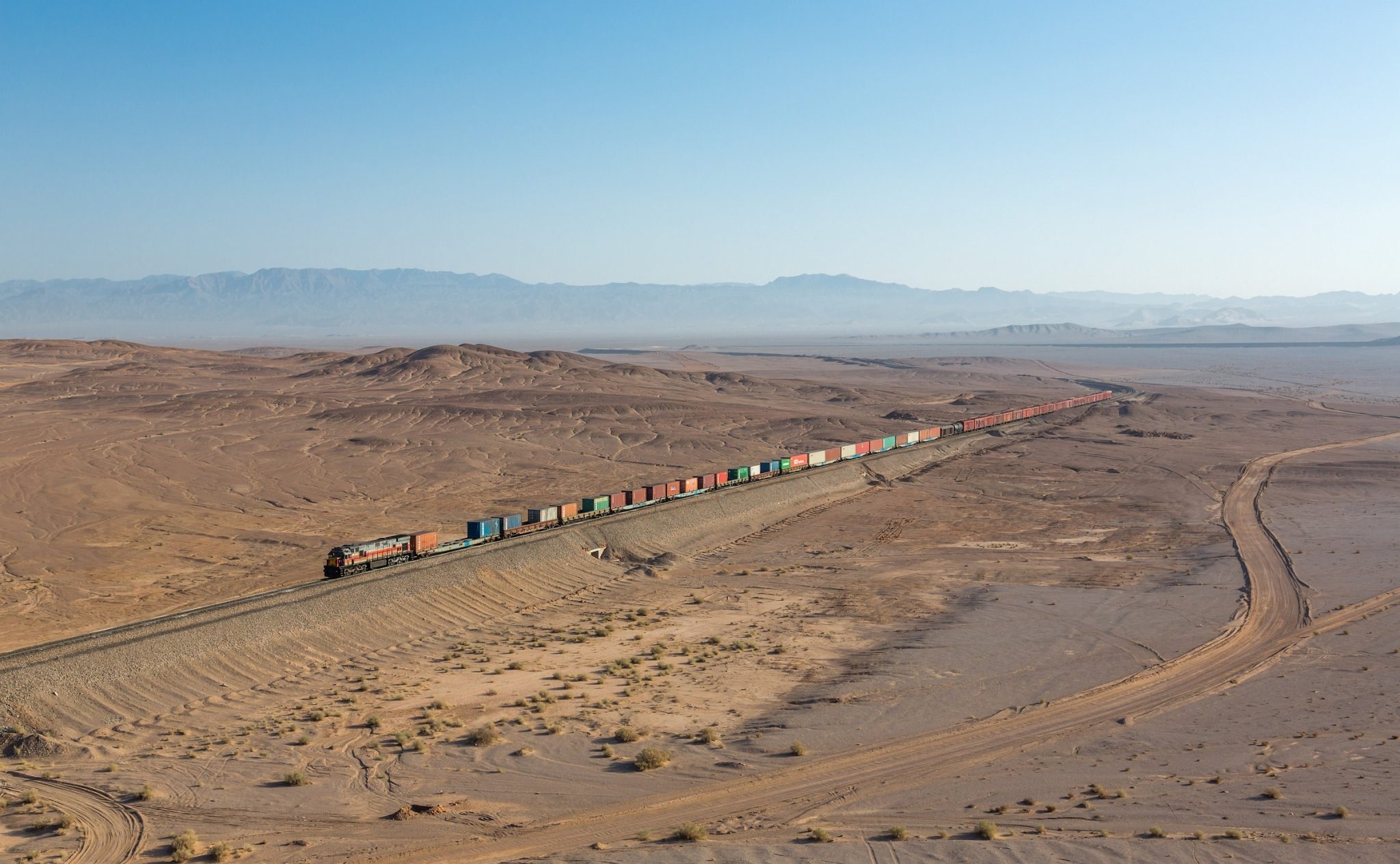
The 1.6 billion dollar new railway project announced by Iran in the final quarter of 2025 is being assessed not merely as infrastructure construction, but as a geopolitical counter-move. Announced under the heading "Southern Silk Road Revival", the project represents a strategic step developed by Iran to counter the risk of permanent bypass on the Middle Corridor route extending from China through Central Asia and Türkiye to Europe. The substantial investments attracted by the Middle Corridor (a Caspian Sea-crossing connection via Kazakhstan–Azerbaijan–Türkiye) and the accelerating plans for the Zangezur Corridor (direct access to Türkiye via Azerbaijan–Armenia) are forcing Iran to expedite its own alternative.
The core component of the project is the 200 km new railway line stretching between Marand and Cheshmeh Sorayya. Once completed, cargo transport from Iran to Türkiye will be able to take place over an uninterrupted land line, rather than via Lake Van ferry or lengthy circumnavigation routes. Iran's Transport Minister Farzaneh Sadegh noted that construction is expected to take approximately 3–4 years.
However, Iran's announcement alone does not complete the full picture. The project's critical second half has already commenced on the Turkish side. In August 2025, Türkiye formally broke ground on its own complementary line, the Kars–Iğdır–Aralık–Dilucu (KIAD) railway. This line is being designed to connect from the Aralık/Dilucu border crossing to Iran's Cheshmeh Sorayya point. This situation indicates that Iran's railway initiative is not merely a "solitary exit route," but rather a bilateral infrastructure strategy being executed in coordination by both countries.
For Türkiye, this line carries a strategic "Plan B" quality comparable to the Zangezur Corridor. Access to Gulf ports via Iran opens alternative doors for Türkiye's trade with South Asia and Africa. Similarly, it provides an uninterrupted overland route for China and Central Asian countries.
This development constitutes a textbook example of the Bypass Network (Channel B) and Dark Network (Channel C) structures defined in earlier analysis:
1. "Land Hedge"—Terrestrial Alternative to Sea Risks
As drone attacks in the Red Sea render maritime shipping increasingly perilous, terrestrial lines are gaining strategic importance in the long term. Once this railway is completed, the China → Central Asia → Iran → Türkiye → Europe route will be fully operational independent of maritime exposure. Similar to DHL's air–land hub established in Riyadh, this structure strengthens the terrestrial backbone of the new logistics matrix designed to circumvent drone threats.
2. Sanctions Evasion—A Lifeline for Russia and Belarus
For Russia, whose Baltic transits have become risky due to U.S. and EU sanctions, this corridor could serve as a "Shadow Rail Corridor". Access is provided from Iran to Central Asia and Global South markets; when necessary, trade hubs on the Turkish side enable indirect access to Europe. This pattern points to the terrestrial version of "dark logistics" practices observed in Shadow Fleet operations.
3. A Reality Check—This Is a 2030 Story
Despite headlines proclaiming the project "started," physical completion is not expected before 2029–2030. For this reason, the project is not a solution to the current Red Sea crisis, but rather a long-term geopolitical infrastructure move.
4. Compliance Risk for Western Shippers
Any route passing through Iran carries high compliance risk for U.S. and EU firms due to American sanctions. Even when this corridor is completed, it will not be usable for Western cargo owners; the primary user base will be China, Russia, Central Asian countries, and non-sanctioned Global South actors.
In conclusion, the Iran–Türkiye railway line is forming the terrestrial backbone of the new global trade architecture taking shape in the 2026–2030 period. It is becoming the rival to the Middle Corridor from the east, an alternative to Zangezur from the west, and the potential logistics spine of shadow networks. The project carries the potential to create a "grey economy corridor" beyond the reach of Western military power, yet under intense pressure from Western sanctions.
Key Points:
Iran is constructing a 200 km railway valued at 1.6 billion dollars on its Turkish border.
The project is being executed bilaterally with Türkiye's KIAD line.
Once completed, the line will create an uninterrupted land corridor between China–Central Asia–Iran–Türkiye–Europe.
The corridor could serve as a Baltic bypass alternative for Russia and Belarus.
The route is unusable for Western shippers due to high sanctions risk.
The project will not be ready before 2029–2030; it is not a short-term solution, but a strategic infrastructure move.
Author: SedatOnat.com

