

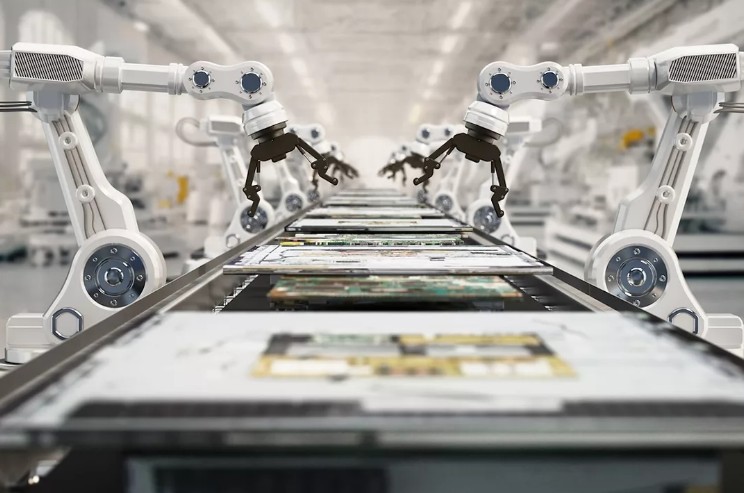
Gartner's latest report reveals that the global manufacturing sector requires restructuring in advanced automation implementation. While most companies acknowledge automation's role in creating competitive advantage, the report shows they are avoiding the necessary transformation steps required for implementation.
\nThe research is based on a survey of 128 senior supply chain executives (Chief Supply Chain Officers – CSCO). Nearly half of respondents (48%) agreed that their current manufacturing strategies will not achieve expected business targets over the next three years.
\nThe Gartner report emphasizes that two-thirds of companies (66%) are not implementing the aggressive redesigns required in their manufacturing operations. This contradicts rising expectations for advanced automation and digital manufacturing.
\nGartner Vice President and Chief Analyst Simon Jacobson stated in a declaration dated October 28:
\n"Executives want to embrace new capabilities that will boost competitiveness, but 66% of respondents say supply chain and manufacturing integration is the biggest challenge. This troubling reality should push leaders to reinvent their operations."\n
\n
Robotic automation's share is growing rapidly
\nAccording to Gartner data, 21% of manufacturing operations are currently performed by advanced automation systems. This share is expected to reach 32% within three years. Conversely, the share of human labor in manufacturing is projected to decline from 52% to 40%.
\nThese figures show that robotic systems, sensor technologies, and data-driven production planning are increasingly becoming central to manufacturing. However, according to Gartner, this transformation must be managed not only through technology investment but also alongside organizational culture and process changes.
\nManufacturing strategies need a "reset"
\nThe overall conclusion of the report is that the manufacturing industry must enter a reset process in advanced automation. Gartner recommends the following steps to companies:
\n- \n
Integrate new technologies incrementally: Technologies such as artificial intelligence (AI), machine learning, and autonomous production systems should be incorporated into production lines at an early stage.
\n Empower facility managers: Factory managers should be given authority for data-driven decision-making; the use of real-time production analytics should be encouraged.
\n Accelerate supply chain–manufacturing integration: Production planning, procurement, maintenance, and logistics processes should be integrated under a single digital ecosystem.
\n Optimize human–machine collaboration: The goal of automation should not be to eliminate humans entirely but to create hybrid models that support decision-making processes.
\n
Management awareness growing but action lacking
\nGartner notes that manufacturing leaders' technological awareness is higher than in the past, but most are adopting a "wait-and-see" approach in strategic decisions. In particular, mid-sized manufacturers are slowing the process due to investment costs, transformation risks, and workforce resistance.
\nThe report emphasizes that advanced automation can improve not only manufacturing speed but also supply chain flexibility, quality, and sustainability. However, according to Gartner, "technology investment alone without an implementation strategy will not deliver productivity gains."
\nConclusion: A sector at the threshold of industrial transformation
\nAccording to Gartner's analysis, the manufacturing sector is currently struggling to balance technology investment with organizational change. Companies must accelerate their transition to a flexible, data-driven, autonomous systems-enabled manufacturing ecosystem in the coming period.
\nSuccessfully completing this transformation will be one of the key factors determining not only efficiency but also competitive advantage and supply chain resilience.
\nKey Takeaways:
\n- \n
48% of 128 CSCOs believe manufacturing strategies will be insufficient over the next 3 years.
\n 66% of companies face challenges in manufacturing-supply chain integration.
\n Automation's share will rise from 21% to 32%, while human labor share falls from 52% to 40%.
\n Gartner called for a manufacturing "reset" (restructuring).
\n Recommendations: Integrate new technologies, empower facility managers, accelerate integration, adopt hybrid models.
\n Automation supports not only manufacturing speed but also flexibility, quality, and sustainability goals.
\n
----------
\n\n--------------------
\nAuthor: SedatOnat.com
\n--------------------
\n\nWe would be delighted to receive your feedback.
\nWe wish you happy reading in advance.
\n\n
