

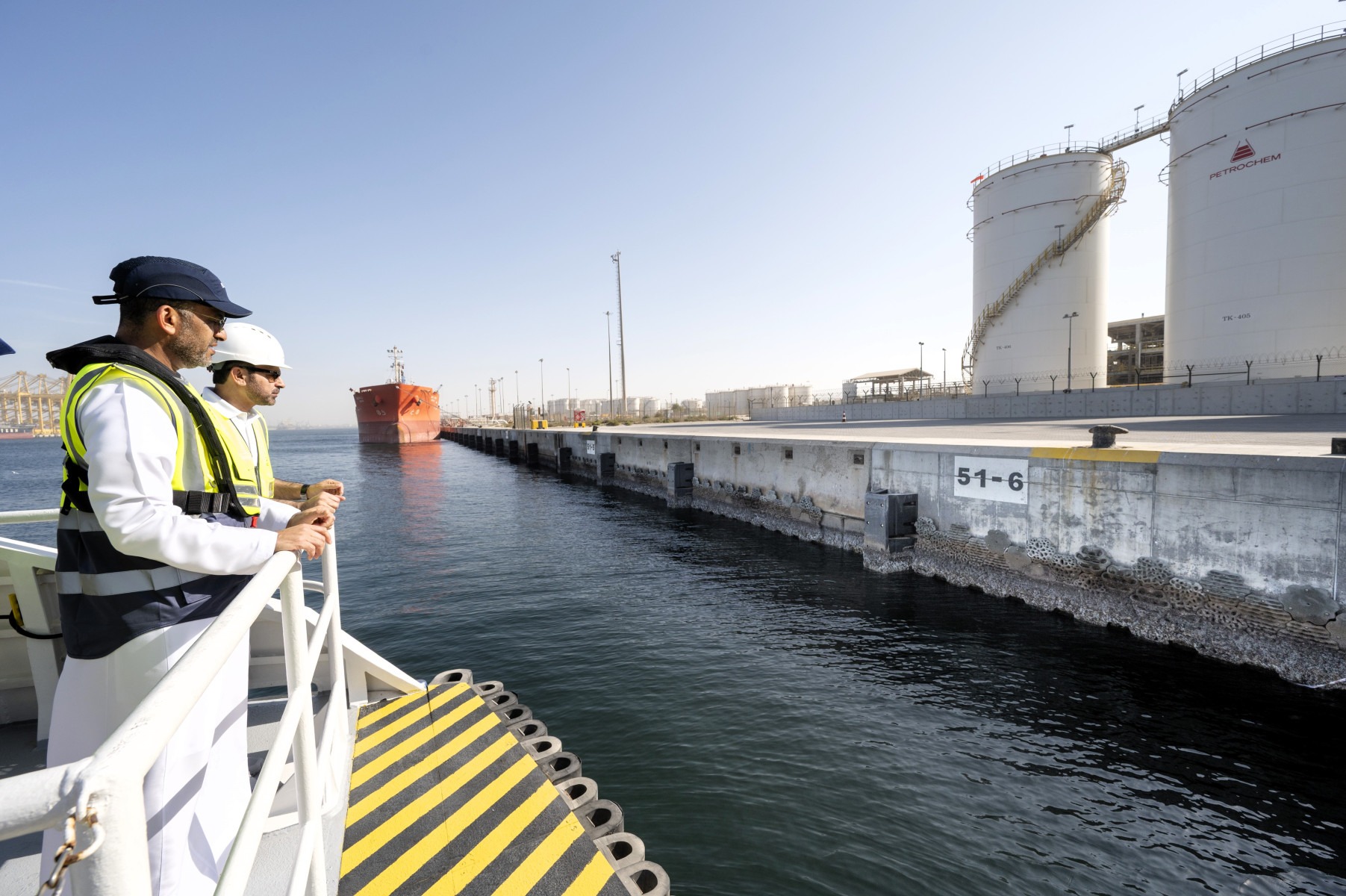
Global port and logistics operator DP World has taken a significant step forward in its commitment to marine ecosystem conservation and enhancing the environmental resilience of port infrastructure at Jebel Ali Port. According to the company's announcement, 1,000 eco-engineered Living Seawalls panels have been successfully installed at the port facility, completing the first phase of the program. The project aims to ensure that port infrastructure not only supports commercial operations but also creates functional marine habitats.
The Living Seawalls panels are based on the Living Seawalls program developed by the Sydney Institute of Marine Science. These modular panels are designed with shapes, grooves and surface textures that mimic natural rock formations, enabling marine organisms such as mussels, corals, algae and small crustaceans to attach to the surfaces and develop complex micro-habitats over time.
Target for Region's Longest Continuous Structure
DP World plans to expand the Living Seawalls installation at Jebel Ali Port to 6,000 panels by 2028. Once this scale is reached, the project will be positioned as the longest continuous ecological coastal structure in the Middle East region. The company views this structure not merely as a local environmental initiative but as a scalable global model.
Abdulla Bin Damithan, DP World GCC CEO and Managing Director, emphasizes that ports play a critical role in coastal resilience. According to Bin Damithan, science-based designs enable continuous trade while simultaneously allowing natural life to flourish. This approach transcends traditional port development thinking and highlights the concept of nature-positive infrastructure.
Biodiversity and Scientific Monitoring
The biological monitoring process for the Living Seawalls panels at Jebel Ali Port will commence in 2026. This work aims to provide data to global scientific research on ecological resilience in port environments. The monitoring will include regular analysis of species diversity, colonization rates and ecosystem functions.
DP World notes that this scientific approach will not only measure environmental performance but also contribute to developing port planning and maintenance strategies in a data-driven manner.
Findings from the Callao Pilot
The Jebel Ali implementation is based on a pilot project previously conducted at the Port of Callao in Peru. During a 12-month monitoring period on the Callao Living Seawalls panels, 66 species belonging to 12 different marine organism groups were identified. Among these, seven species were observed only on Living Seawalls surfaces.
The pilot study also found no invasive species, while algal diversity and ecological functions increased. These results demonstrate that Living Seawalls panels improve not only species numbers but also ecosystem functionality.
Strategic Framework and Global Objectives
The Jebel Ali project is being implemented as part of DP World's Ocean Strategy and aligns with the global biodiversity targets established under the Kunming–Montreal Global Biodiversity Framework. This framework aims to reverse the negative impacts of human activities on nature and halt nature loss by 2030.
DP World views adapting port infrastructure to be compatible with biodiversity as a strategic investment in terms of long-term climate adaptation, coastal protection and social license. The dense concrete and steel structures surrounding ports create challenges for natural life, while Living Seawalls transform these hard surfaces into ecologically active areas.
Overall Assessment
The first 1,000 Living Seawalls panels installed by DP World at Jebel Ali Port demonstrate that ports can be more than just trade centers; they can also function as ecosystem-supporting infrastructure. Should the project reach 6,000 panels by 2028, Jebel Ali could become a global example of an integrated port showcasing science, sustainability and logistics. This approach provides an applicable and scalable reference model for other major ports worldwide.
Key Highlights:
DP World has installed 1,000 Living Seawalls panels at Jebel Ali Port.
The project will be expanded to 6,000 panels by 2028.
The panels mimic natural rock structures to enable marine organisms to attach and establish habitats.
Biological monitoring studies will commence in 2026.
The Callao pilot identified 66 species with no invasive species observed.
The project is aligned with Ocean Strategy and the Kunming–Montreal Global Biodiversity Framework.
Author: SedatOnat.com

