

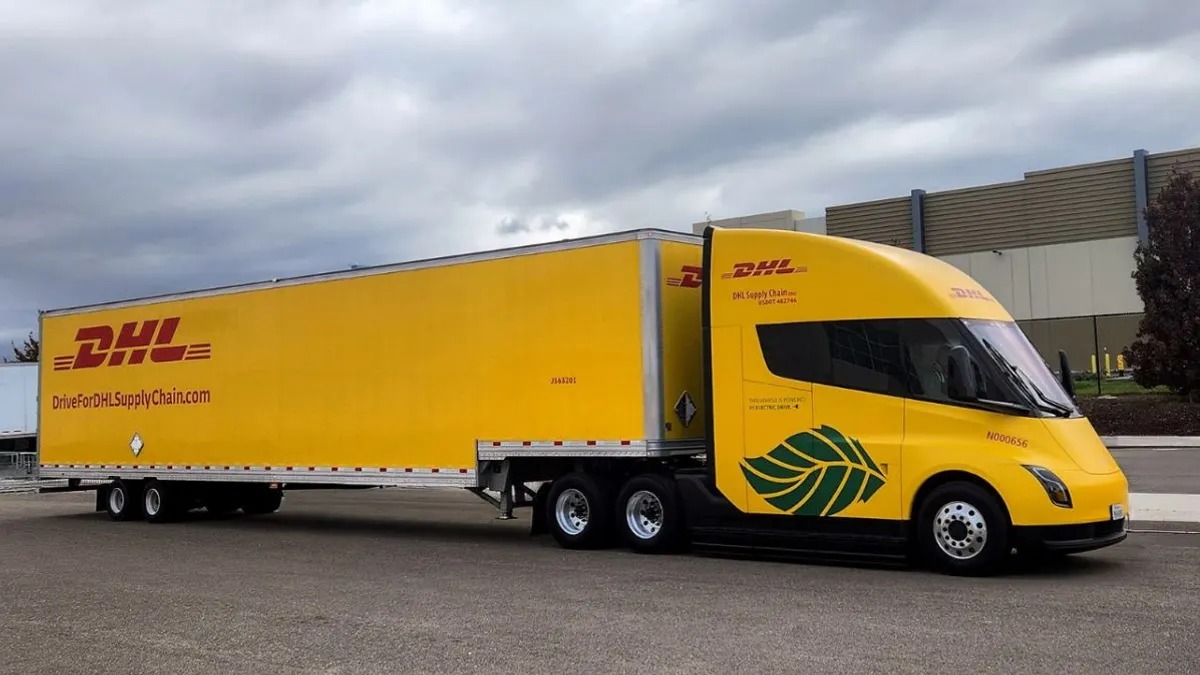
Global logistics provider DHL Supply Chain has announced the integration of Tesla Semi into its operations, advancing its electrification strategy for heavy-duty trucking. The electric tractor deployed by the company in the Central California region covers approximately 100 miles daily and requires charging only once per week. This initiative is viewed as a significant indicator of how heavy-duty vehicle electrification can be scaled in practice, aligned with DHL's long-term net-zero objectives.
According to information shared by DHL, the pilot program involving Tesla Semi extended beyond short-distance distribution operations. Within the pilot scope, the vehicle was also tested on a 390-mile long-haul route with 75,000 pound gross combined weight. This performance demonstrates that range and payload capacity combinations previously unattainable by electric heavy-duty vehicles are now feasible.
DHL Supply Chain North America Transportation President Jim Monkmeyer commented on the pilot results as follows:
"With its range of up to 500 miles, the Semi unlocks opportunities that were previously beyond the limits of heavy-duty EVs."
This statement indicates that Tesla Semi can be utilized not only in urban or regional distribution, but also in medium to long-distance hauling.
2026 and Beyond: EV Fleet Scaling
DHL does not view the Tesla Semi deployment as a single pilot initiative. The company plans to add more Tesla Semis to its operations throughout 2026. This step aims to strengthen the ground transportation component of DHL's zero-emission (net-zero) target by 2050.
According to DHL's 2024 environmental report, the majority of the company's total carbon emissions still stem from air transportation. However, ground freight accounts for the second-largest share at 22% of total emissions. Consequently, every structural transformation in ground transportation creates meaningful impact on the company's overall carbon footprint.
Existing EV Infrastructure and Emission Impact
DHL Supply Chain currently operates 150 electric vehicles in its North American operations. With the addition of Tesla Semi to the fleet, the company projects annual greenhouse gas emission reductions of approximately 50 metric tons from this vehicle alone. While this figure may appear modest for a single vehicle, the cumulative impact becomes significant when considering DHL's planned scaling.
The company is also rapidly increasing its use of renewable energy in ground transportation. According to DHL's annual environmental reports, the renewable energy share in the ground freight segment increased from 12.7% in 2023 to 18.4% in 2024. This growth represents the highest percentage point increase among all transportation modes.
2030 and 2050 Roadmap
DHL's medium and long-term targets are clearly defined:
Convert two-thirds of its fleet to EVs by 2030,
Achieve net-zero emissions across all operations by 2050.
As of today, electric vehicles in the DHL fleet constitute more than 41% of the targeted EV ratio. The introduction of heavy-duty vehicles such as Tesla Semi has the potential to rapidly accelerate this proportion.
Industry Context and Competition
DHL's move is part of growing alternative fuel competition in the logistics and transportation sector. Other major carriers are pursuing similar transformation plans:
Werner Enterprises operates a mixed fleet using electric, hydrogen fuel cells, CNG/RNG, and renewable diesel, targeting 55% emission reductions by 2035.
Estes Express Lines plans to convert more than 90% of its box truck fleet to zero tailpipe emissions by 2040 and achieve 2050 net-zero targets.
This landscape demonstrates that platforms such as Tesla Semi can play a transformative role not only for DHL, but for the entire heavy-duty trucking sector.
Strategic Assessment
DHL Supply Chain's Tesla Semi pilot proves that electric heavy-duty vehicles have become an operational reality. Weekly charging requirements, extended range, and high payload capacity demonstrate that EV trucks are becoming competitive not only environmentally, but also economically and operationally. The scaling planned for 2026 indicates this transformation can accelerate.
Key Takeaways:
DHL Supply Chain deployed Tesla Semi in Central California.
Daily usage ~100 miles, charging needed once weekly.
Pilot encompassed 390-mile long-haul routes with 75,000 lb payload.
DHL plans to add more Tesla Semis in 2026.
Ground freight accounts for 22% of DHL emissions.
Target: 2/3 of fleet EVs by 2030, net-zero by 2050.
Author: SedatOnat.com
Your feedback would make us happy.
Wishing you happy reading in advance.

