

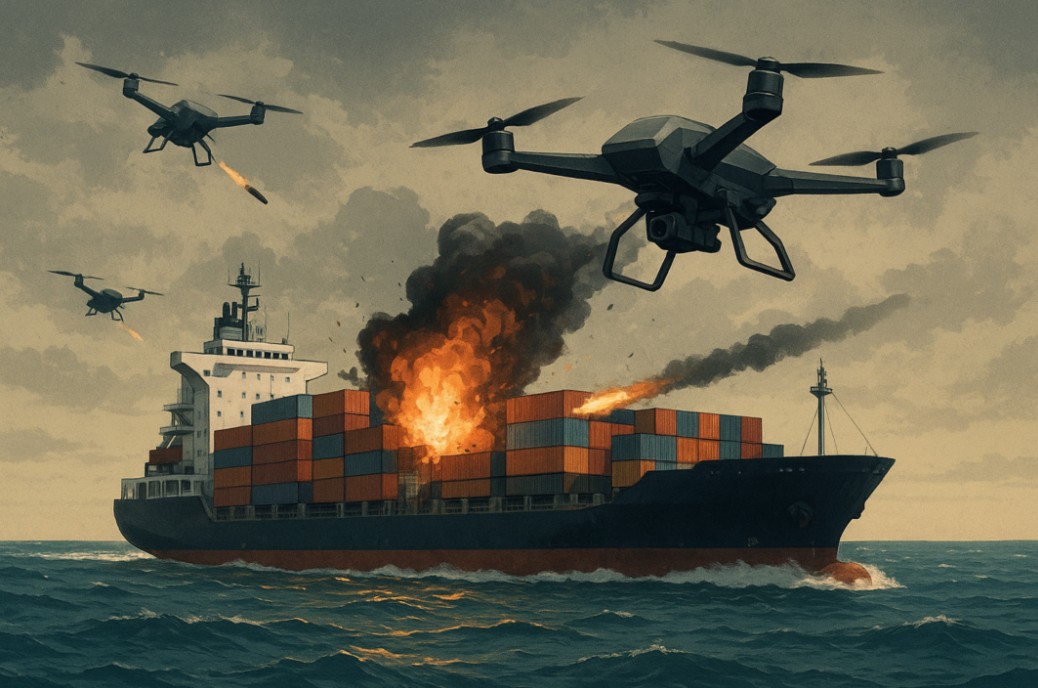
2025 marks a watershed moment in global maritime security as the industry undergoes unprecedented restructuring. Historically, the primary threat to merchant shipping has been piracy—seizing vessels to extort ransom. In waters off Somalia and the Gulf of Guinea, pirate operations aimed to capture ships and crews to extract economic gain. But as of 2025, the threat profile has fundamentally changed: the objective is no longer to seize vessels, but to destroy them. This transformation is accelerating as state and non-state actors increasingly deploy low-cost unmanned systems at scale.
The new security paradigm is rooted entirely in remote warfare. As demonstrated by Houthis attacks in the Red Sea, strikes in the Black Sea during the Ukraine-Russia conflict, and assaults on Baltic oil terminals, the maritime sector has become a target for lightweight, affordable, and expendable drones. The fact that Shahed-type drones cost only $20,000–40,000 while a container ship is worth over $100 million creates a highly sustainable economic dynamic for attackers. In this asymmetric warfare environment, expensive commercial assets face relentless pressure from cheap attack vectors.
This emerging 2025 threat landscape rests on three fundamental vulnerabilities:
1. Defenseless Ship Design:
Unlike warships, merchant vessels do not carry hard kill systems (such as Phalanx CIWS, anti-drone weapons, or short-range missiles). These slow-moving platforms with large radar signatures possess no physical defense mechanisms against drone strikes. This renders commercial ships easy targets across vast stretches of ocean.
2. Swarm Tactics:
As seen in the Red Sea and Black Sea, attacks typically occur as swarm attacks: multiple aerial drones and several Unmanned Surface Vessels (USVs) are deployed simultaneously. Even if naval escorts disable several, a fourth or fifth unit reaches the target. This makes merchant ship security difficult to guarantee, even under naval protection.
3. Port Security Gaps:
The danger is no longer confined to open ocean; port infrastructure is at risk as well. Strikes on Port Sudan and hits on the Primorsk oil terminal demonstrate that ships at berth are stationary targets and easy prey. This disrupts terminal operations and creates massive insurance exposure.
This security transformation directly impacts supply chain decisions. The recent disagreement between Maersk–Hapag-Lloyd (Gemini Cooperation) and the Suez Canal Authority exemplifies this trend. The SCA announced that vessels would return to the Red Sea in December 2025, but Maersk and Hapag-Lloyd immediately issued a "no timeline" statement. The reason for this cautious approach is clear: in the new threat environment, risk extends beyond voyage delays to physical damage that can sideline vessels for months.
War Risk insurance costs have risen sharply due to the high success rate of drone strikes. Commercial ships suffer severe damage when drones are precisely guided toward critical areas such as the engine room, bridge, or fuel lines. Repair timelines range from two to six months and directly reduce line capacity.
Moreover, the 2025 threat is not limited to the Red Sea.
Sea drones are actively deployed in the Black Sea.
Energy infrastructure is targeted in the Baltic.
Many routes, including India–Russia corridors, are losing flexibility.
In conclusion, 2025 represents a shift where the oceans are no longer viewed as "neutral trade corridors" but rather as dual-use conflict zones. The falling cost of attack technology, the proliferation of attack capacity, and the defensive inadequacy of merchant vessels leave global maritime transport facing a fundamental, long-term shift in security paradigms.
Key Takeaways:
Maritime security is shifting from piracy to remote warfare models.
The asymmetric cost gap between cheap drones and expensive ships makes attacks sustainable.
Merchant vessels lack hard kill capability; they are defenseless.
Swarm attacks increase success rates.
Ports are now high-risk targets; the attack geography is expanding.
Maersk and Hapag-Lloyd's refusal to set a timeline for Red Sea returns stems from this security picture.
Author: SedatOnat.com

