

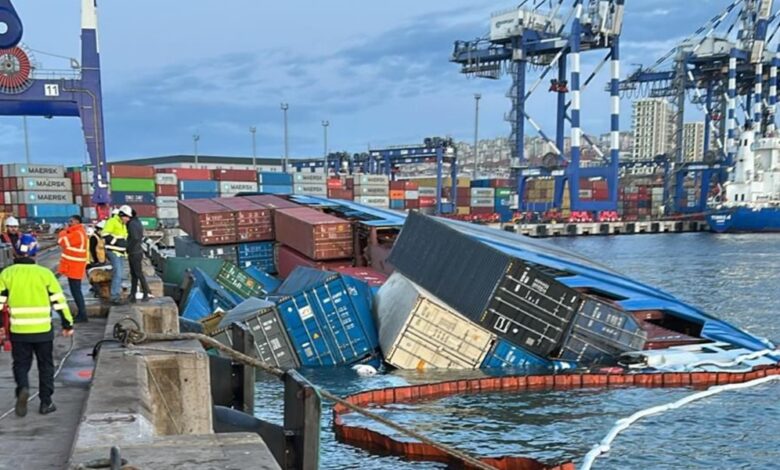
A container vessel engaged in cargo operations for an extended period unexpectedly heeled over and partially submerged at a port within Türkiye's borders. The incident occurred during the normal flow of operations at the terminal. The vessel, registered in official records as a "Boxship" type general cargo vessel, is recognized in the maritime sector for its medium tonnage capacity. Its primary mission was to deliver routine import and export cargo to various Mediterranean destinations. At the moment of the accident, a sudden imbalance developed on one side of the hull, and the vessel executed an uncontrolled maneuver just as it was approaching the dock. This unexpected movement caused the ship to rapidly heel over and created a serious state of panic within the port area.
\nWitnesses in the vicinity reported that the distance between the water level and the vessel narrowed very rapidly. It is particularly noted that the ship's crew experienced a sudden loss of stability due to cargo distribution irregularities during the crane operation. Port authorities, in cooperation with specialists from the General Directorate of Coastal Safety and the Ministry of Transport and Infrastructure, launched a coordinated salvage operation. Emergency response teams quickly mobilized to ensure the safe evacuation of the crew. Since some of the containers on the vessel posed a risk of sinking below the water surface, barriers were erected as part of emergency procedures. This aimed to mitigate the risk of potential environmental pollution and cargo loss.
\nPreliminary investigations following the accident raised the possibility of negligence or systematic error in the stowage plan. Experts emphasize the importance of cargo planning and center of gravity calculations for vessels entering the port. Under maritime standards, according to International Maritime Organization (IMO) rules, every vessel's balance, trim, and stability calculations must be regularly updated. It remains unclear whether these procedures were fully implemented in this case. Nevertheless, initial findings suggest that the incorrect positioning of cranes during the operation disrupted the load balance of the vessel.
\nFollowing the accident, the port authority halted operations at the scene and prioritized salvage operations. Tugboats attempted to right the capsized vessel and prevent remaining containers from sinking underwater. Meanwhile, other vessels waiting at the port were directed to anchor in open waters for safety reasons. Some port calls were cancelled while others were rerouted to alternative ports. Port State Control inspectors examined the vessel's technical history and records. Additionally, classification society authorities are expected to visit the accident site to conduct damage assessments.
\nAccording to information obtained from the scene, the number of injuries was quite limited and there were no fatalities. However, there is a risk of fuel and oil spillage into the marine environment. For this reason, hazardous material containment teams rapidly deployed oil booms and absorbent materials to protect water quality. The port authority contacted international shipping companies to inform cargo owners and initiated possible insurance procedures. Initial estimates suggest that material damage could be substantial. The vessel owner's insurance company plans to conduct a rapid inspection process through its P&I Club to address the resulting damages.
\nIndustry experts have drawn attention to the importance of risk assessment and regular training to prevent such accidents. Particularly, the communication between crane operators and ship crew must be at a level that will prevent possible deviations during loading operations. In such large-volume vessels, even the smallest imbalance can lead to loss of control. This accident once again highlights the importance of strict enforcement of safety standards in the maritime sector.
\nKey Points
\n- \n
A sudden load imbalance occurred as the vessel was approaching the dock.
\n Errors during the crane operation are considered the trigger for the accident.
\n The General Directorate of Coastal Safety and Ministry of Transport and Infrastructure intervened.
\n A comprehensive salvage operation was launched to minimize environmental pollution risk.
\n Port State Control inspectors and classification society authorities began investigations.
\n No fatalities were reported, though material damage is expected to be substantial.
\n
---
\n\n-------------------
\n\nWe would be delighted to receive your feedback.
\nWishing you happy reading.
\n
