

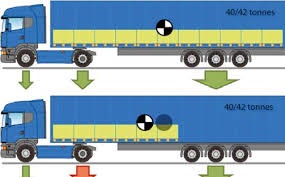
Europe's leading railway institutions — CER, ERFA, UIRR, UIP and UNIFE — have issued a strongly-worded joint statement opposing the European Council's approach under the Weights and Dimensions Directive (WDD) to grant cross-border transit permits for 44-ton fossil-fuel trucks and mega-trucks known as European Modular Systems (EMS) or "gigaliners". According to sector representatives, this regulation reverses the EU's long-established rail–intermodal policies, raising the risk of "reverse modal shift".
Currently in the EU, cross-border road transport is generally capped at 40 tons. This limit has been a key parameter making the transport of heavy and long-distance cargo via rail freight economically more attractive. The Council's approach eliminates this advantage by permitting 44-ton fossil-fuel trucks. Sector representatives argue this constitutes a policy that subsidizes roads while weakening railways.
The institutions' statement references a 2024 independent study, noting that this decision will produce three critical consequences:
Increased CO₂ Emissions: Shifting cargo from rail to road will significantly raise emission intensity.
Infrastructure Damage: Higher axle loads will increase maintenance costs across the EU's road network.
Safety Risk: The proliferation of gigaliner vehicles poses risks to both highway safety and vulnerable urban areas.
Another factor intensifying the statement's tone is the allegation that the European Commission has backed down on the Combined Transport Directive. The railway sector had argued that the EU's Greening Freight Transport Package could only balance heavier road transport regulations if paired with parallel measures to incentivize rail investment. However, the Combined Transport Directive is now reportedly being entirely withdrawn or seriously weakened.
The joint statement emphasizes this key passage:
"The current Council approach risks achieving the exact opposite: prioritizing cheaper, high-emission road transport over sustainable rail and intermodal chains."
For this reason, sector representatives are calling on the European Parliament to take a firmer stance once the file completes the Council stage and moves to the trilogues process. The Parliament will shape the final text of the WDD through trilateral negotiations among the Council, Commission and Parliament. The railway sector is making three core demands to Parliament:
The 44-ton limit should apply only to ZEV (Zero-Emission Vehicles).
EMSys / gigaliners vehicles must comply with intermodal terminal compatibility, making them loadable onto trains.
Member states must be required to conduct rigorous impact assessments before permitting cross-border heavy truck use.
Sector representatives argue that without these modifications, the EU's goal of doubling rail freight volume by 2050 will become impossible. At a time when Asia–Europe corridors are diversifying and the EU is tightening its carbon reduction policies, a shift in freight back to roads threatens climate targets, infrastructure budgets and logistics security alike.
Political Balance: The Council – Parliament – Railway Triangle
The European Council states it aims with the WDD to "increase logistic flexibility and boost road efficiency".
The railway sector believes this approach violates modal balance principles and provides "hidden subsidies" to road transport.
The European Parliament will now have the final say in trilateral negotiations and an opportunity to revisit the decision's environmental, economic and logistics dimensions.
In conclusion, the WDD file represents a critical test of the EU's vision for the future of freight transport. The sector warns that absent Parliament's intervention, rail modal share — a cornerstone of Europe's green logistics policy — may experience a sharp decline in coming years.
5. Key Points
Key Points:
The Council seeks to open 44-ton fossil trucks and gigaliner EMS for cross-border use.
The railway sector says this will trigger reverse modal shift and divert cargo to roads.
Withdrawal or dilution of the Combined Transport Directive is viewed as a "betrayal" by the sector.
Three demands from Parliament: 44-ton approval only for ZEV, EMS–intermodal compatibility, mandatory impact assessment.
Otherwise, the EU's 2050 rail freight doubling goal will become unachievable.
Author: SedatOnat.com

