

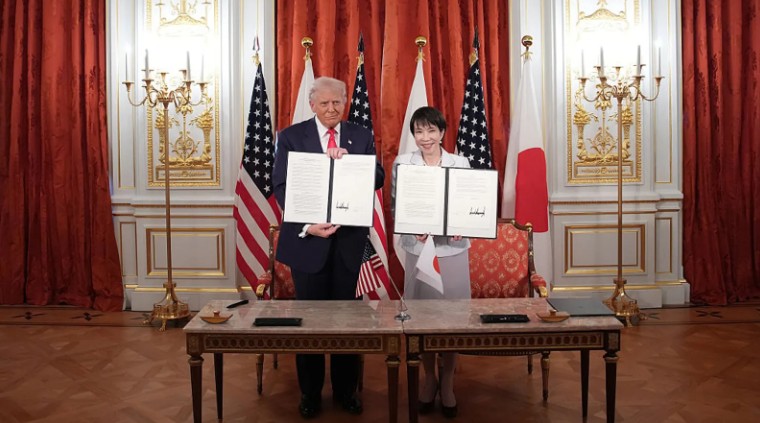
The United States and Japan have signed a new framework agreement to ensure the secure supply of critical minerals and rare earth elements, which are vital for both nations' industrial and national security interests.
\nThe agreement was announced at a meeting between US President Donald Trump and Japanese Prime Minister Sanae Takaichi held at Akasaka Palace in Tokyo. While the document carries nonbinding status, it envisions coordinated investment and policy measures by both nations to strengthen mining, ore separation, processing, and supply networks.
\nConcrete projects to be selected within six months
\nUnder the framework, the parties will announce plans within the next six months to select and finance priority projects to support the raw materials supply chain. During this period, the two countries will also host a "Mining, Minerals and Metals Investment Ministerial" to discuss investment priorities with representatives from the public and private sectors.
\nThe agreement's focal points include:
\n- \n
Establishment of a US–Japan Critical Minerals Supply Security Rapid Response Group,
\n Exploration of mutual stockpiling possibilities,
\n Investment in mineral recycling technologies,
\n Development of new regulatory mechanisms compatible with national security laws.
\n
The newly established Rapid Response Group will operate under the leadership of the US Secretary of Energy and Japan's Minister of Economy, Trade and Industry. The group will identify bottlenecks in the supply chain and develop rapid action plans based on priority mineral types.
\nCurbing uncoordinated investments
\nProf. Tom Moerenhout of Columbia University, commenting on the agreement, said the two countries would "reduce the risk of pursuing parallel and uncoordinated strategies."
\n"The US, Japan, Australia, Canada, and the EU are currently spending billions of dollars on different links of the same supply chains. Without coordination, these efforts both inflate costs and fail to address vulnerabilities," he said.\n
\n
Aiming to reduce dependence on China
\nThe agreement comes at a time of heightened trade and technology tensions in US–China relations. The Trump administration views reducing mineral dependence on China as a national security priority.
\nJapan, meanwhile, imports approximately 60% of rare earth elements from China. Since the export crisis in 2010, Tokyo has been working to develop alternatives in supply diversification and recycling technologies.
\nWithin days of his Tokyo visit, Trump is scheduled to meet with Chinese President Xi Jinping in South Korea to discuss trade ceasefires and export restrictions.
\nFollowing the US–Australia agreement
\nJust a week before this agreement, the US had signed an 8.5 billion-dollar critical mineral investment framework with Australia. This project, which includes companies such as DP World, Arafura Rare Earths, and Northern Minerals, aims to expand mining and processing capacity through both public and private sector investments.
\nThe US–Japan framework signed in Tokyo is viewed as the second step in Washington's "strategy of building critical mineral supply chains with allied nations." These measures are part of plans to construct an independent global system separate from China-centric supply networks.
\nSteps forward
\nGoing forward, the two countries will prioritize financing mining, ore processing, and refining facilities in North America and the Asia-Pacific region. They will also ensure secure supplies of minerals such as lithium, nickel, cobalt, tungsten, and rare earth elements, which play critical roles in semiconductors and the defense industry.
\nAccording to experts, such multilateral frameworks will prove decisive in insulating mineral resources needed for energy transition and green technologies from political and commercial risks.
\nKey Points:
\n- \n
The US and Japan have signed a nonbinding framework agreement on critical mineral supply security.
\n Priority projects will be selected and financed within 6 months.
\n A Rapid Response Group will be established; mutual stockpiling and recycling investment will be evaluated.
\n Objectives: Reduce dependence on China, establish a coordinated supply chain infrastructure.
\n The agreement follows the similar framework signed by the US and Australia last week.
\n Scope: Lithium, cobalt, nickel, tungsten, and rare earth elements.
\n According to experts, this framework carries critical significance for global energy transition and strategic mineral supply security.
\n
----------
\n\n--------------------
\nAuthor: SedatOnat.com
\n--------------------
\n\nWe would be delighted to receive your feedback.
\nWishing you happy reading in advance.
\n
